Konkuk University professor's new book maps the present and future of Korean democracy
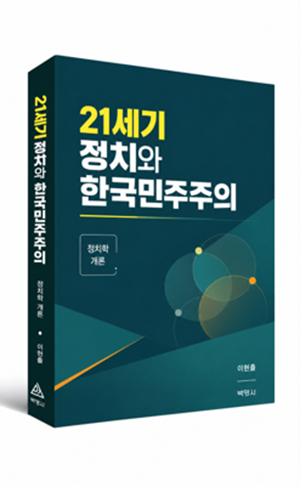
’21st Century Politics and Korean Democracy’ covers everything from basic political science theory to political reality
An introduction to political science that addresses new political questions in an era of population decline, climate crisis and artificial intelligence
SEOUL, South Korea–(Newswire)–Konkuk University professor Lee Hyun-chool (Department of Political Science and International Relations) has published a new book, ’21st Century Politics and Korean Democracy: An Introduction to Political Science’ (Parkyoung Publishing).
Building on basic concepts of political science such as the state and government, political parties and elections, and civic participation, the book looks at the path Korean democracy has taken. Amid political polarization and social conflict, it asks how people with different values and interests can live together.
Starting from the basics of politics and democracy, the book broadens the discussion to political thought and the state, government and bureaucracy, parties and elections, civic participation and political culture, the welfare state and political economy, and international politics and the world order. While reviewing the history and achievements of Korean democracy, it also deals with how citizens’ diverse demands are represented and how accountability for political decisions can be enforced.
In particular, it focuses on new challenges facing politics today, such as demographic change, the climate crisis and digital transformation. The book links issues such as ‘How can the basis of community life be maintained in regions where the population is shrinking?’, ‘How should the costs and responsibility of responding to the climate crisis be shared?’ and ‘How do digital platforms change the public sphere where citizens share opinions, and when artificial intelligence takes part in decision-making, who controls those decisions and who is accountable?’ to questions of intergenerational justice, the sustainability of local communities and democratic accountability.
Each topic is organized around key questions. University students learning political science for the first time can learn its main concepts and theories, while general readers interested in Korean politics can look at familiar political phenomena from several perspectives.
“There is one question that runs through this book. How will we live together?” Lee said.
Website: http://www.konkuk.ac.kr
Media contact: Konkuk University Communication Office, Choi Ji-hee, 02-450-3131~2
© NEWSNINE. Unauthorized reproduction and redistribution prohibited.
Related Stories
MoreWWF to restore Garolim Bay tidal flats through public-private partnership
WWF signed a five-party agreement on Nov. 20 with the oceans ministry, South Chungcheong Province, Taean County and the Korea Fisheries Infrastructure Public Agency to restore about 40 ha of tidal flats in Garolim Bay from 2027.