WWF to restore Garolim Bay tidal flats through public-private partnership
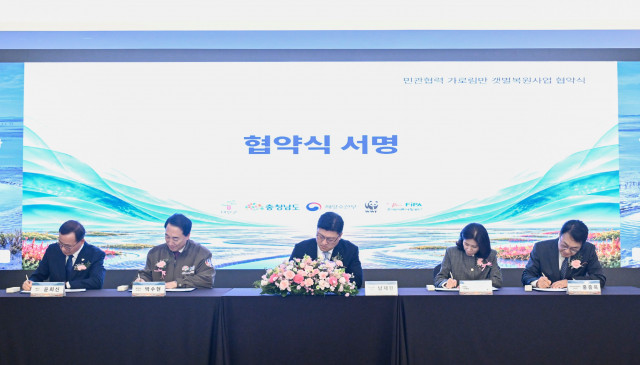
Five-party agreement signed with the Ministry of Oceans and Fisheries, South Chungcheong Province, Taean County and the Korea Fisheries Infrastructure Public Agency to restore tidal flats
About 40 ha of Garolim Bay tidal flats to be restored over three years from 2027, with removal of abandoned aquaculture facilities and follow-up management
Public-private cooperation aims to restore the flats’ natural purification capacity and boost biodiversity
SEOUL, South Korea–(Newswire)–World Wide Fund for Nature (WWF) signed a five-party agreement with the Ministry of Oceans and Fisheries, South Chungcheong Province, Taean County and the Korea Fisheries Infrastructure Public Agency on Nov. 20 at the Peace and Park Convention in Yongsan-gu, Seoul, to carry out a ‘public-private Garolim Bay tidal flat restoration project.’
Garolim Bay is a coastal wetland designated in 2016 as Korea’s first marine protected area for marine life. It is an ecologically important area that is home to a variety of marine species, including spotted seals. However, abandoned aquaculture facilities have been left in place for long periods across its coastal tidal flats, raising the need to restore the ecosystem.
From 2027 to 2029, WWF and the participating organizations plan to remove abandoned aquaculture facilities covering about 40 ha around Mandae Port in Taean County and restore the tidal flats. Through this, they plan to improve habitats for diverse species and help keep the ecosystem stable through monitoring of the restoration’s effects and follow-up management.
WWF, the government, the local governments and the public agency will carry out the project jointly, each based on its own role and expertise. WWF will lead the project, coordinate cooperation among the participating organizations and manage restoration results. The Ministry of Oceans and Fisheries and South Chungcheong Province will provide policy and administrative support, Taean County will handle on-site cooperation and follow-up management, and the Korea Fisheries Infrastructure Public Agency will carry out the restoration work. By combining each organization’s role and expertise in this way, they plan to make the project more effective and lay the groundwork for long-term management.
“Tidal flats are a habitat for diverse marine life and an important natural asset for maintaining healthy marine ecosystems,” said Park Min-hye, secretary general of WWF-Korea. “Together with the participating organizations, we will build a public-private cooperation model to conserve the rich biodiversity of the Garolim Bay tidal flats and pass on their ecological value to the next generation.”
WWF has been carrying out conservation activities for endangered species and their habitats in Garolim Bay since 2025, focusing on spotted seals. With this agreement, it plans to link its existing conservation work and expand efforts to restore the bay’s ecosystem.
Website: https://wwfkorea.or.kr
Media contact: Lee Joo-eun, deputy manager, KPR (PR agency for WWF), 02-3406-2292
© NEWSNINE. Unauthorized reproduction and redistribution prohibited.
Related Stories
MoreKonkuk University professor's new book maps the present and future of Korean democracy

Konkuk University political science professor Lee Hyun-chool has published an introductory political science book that examines Korean democracy and new questions raised by population decline, climate crisis and AI.