Lee Gi-dae Attends Discussion on Local Ordinance Revisions for Social Economy Basic Law

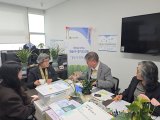
Lee Gi-dae (Democratic Party, Goyang 9), a member of the Gyeonggi Provincial Council’s Economic and Labor Committee, attended the discussion titled ‘Direction for Revising Local Ordinances and Establishing Standard Ordinances Following the Enactment of the Social Economy Basic Law’ as a designated discussant on the 27th at KINTEX in Ilsan. He presented three key directions that local ordinances should encompass ahead of the law’s implementation in March next year.
Lee stated, “As the Social Economy Basic Law was enacted in September and is set to be implemented in March next year, we must now concretely incorporate the law’s intent into local ordinances, policies, and budgets.” He added, “We should review the terminology, policy scope, and support system of the ‘Gyeonggi Province Social Economy Basic Ordinance,’ but we must not limit ourselves to merely unifying existing organizations as a single standard.” He emphasized the need to maintain the expertise and autonomy of various sectors such as social enterprises, cooperatives, community enterprises, self-support enterprises, and social ventures while also establishing common foundations in finance, market access, education, and research.
Furthermore, Lee pointed out, “Policies cannot function properly if the administration plans and the field follows.” He stressed that stakeholders, intermediary support organizations, local governments, researchers, and the administration should collaboratively determine policy priorities, and committees should not merely hold meetings but should actively deliberate and coordinate. He specifically mentioned, “While ensuring the autonomy of local governments and regional strategies, we must clearly delineate roles so that Gyeonggi Province supports areas such as finance, public market access, specialized personnel, and collaborative project foundations that basic local governments find difficult to manage.”
Additionally, Lee noted, “In the field, people are asking what changes when ordinances are revised.” He stated that support systems must be established to facilitate activities that address local issues, including public procurement, market expansion, policy finance linkage, care, and energy transition. He also added, “We should not uniformly reduce social economy policies simply because of financial difficulties,” and emphasized that even when adjusting projects, clear criteria and field opinions should be considered, looking at not only short-term execution results but also social values such as job creation and community recovery.
In conclusion, he mentioned, “In November, I met with stakeholders, Gyeonggi Province Social Economy Center officials, to discuss cooperation between market access and policy finance linkage, as well as between regional and basic support organizations.” He stated, “As revising ordinances is a process of creating answers together with the field, the council will not stop at ordinance revisions but will continue to check whether the opinions from the field lead to actual support and changes in residents’ lives through budget reviews and administrative audits.”
Meanwhile, this discussion was part of the ‘8th Korea Social Economy Fair’ held at KINTEX in Ilsan, organized by the Korean Social Economy and hosted by the Policy and Institutional Improvement Committee of the Korean Social Economy. Following the keynote presentation by the committee chair, designated discussants including the permanent representative of the Jeju Social Economy Network, a deputy researcher at the Social Economy Policy Center, the chairperson of the Everyone’s Economy Social Cooperative, and Lee Gi-dae discussed local ordinance revisions and practical tasks.
© NEWSNINE. Unauthorized reproduction and redistribution prohibited.
Related Stories
MoreDaegu Education Office Signs Agreement for Free School Meals Support in 2027

The Daegu Education Office and the city have signed an agreement to support free school meals through 2027.
Rep. Choi Soon-ja Listens to Voices on Budget Cuts for Out-of-Home Youth Support
Rep. Choi Soon-ja addresses budget cuts and challenges faced by out-of-home youth support facilities.
Kim Kyung-ok Reviews Current Education in Pyeongtaek and Prepares for the Future

Kim Kyung-ok visits Pyeongtaek Education Support Office to assess educational projects and future plans.
Six Taekkyon Practitioners Become Vietnam's First 1st Dan Holders, Marking Globalization of Taekkyon

The Korea Taekkyon Association has produced Vietnam's first six 1st Dan Taekkyon practitioners, advancing the sport's globalization.
